Kollea Small Dehumidifier Review: Technical Lab Breakdown
This compact thermoelectric unit targets small residential micro-environments. It handles tight spaces effectively while facing strict thermodynamic capacity limits.



This Peltier-based device excels at managing enclosed micro-spaces like RVs and closets. However, users must expect modest extraction volumes compared to heavy-duty compressor models.
See our flagship Best Dehumidifier: Top Picks for Basements & Homes.
Verified Specifications
| Category / Type | Peltier Thermoelectric Dehumidifier |
|---|---|
| Rated Output / Capacity | 16 oz (450ml) per 24 hours |
| Power / Motor | 40 Watts continuous draw |
| Build & Materials | Injection-molded white plastic chassis |
| Operating Noise | Approximately 28 dB ultra-quiet acoustic profile |
| Duty Cycle / Runtime | Continuous operation with auto shut-off |
| Dimensions & Weight | 5.9" D x 5.9" W x 10.1" H, 2.2 pounds |
| Key Safety & Controls | Automatic tank-full shut-off with flashing LED |
What We Liked
- Ultra-lightweight chassis at just 2.2 pounds
- Extremely low energy consumption under 40 watts
- Whisper-quiet acoustic output suitable for bedrooms
- Clear transparent tank with visible water volume markers
- Reliable automatic shut-off safety protection feature
Trade-Offs
- Limited daily extraction volume for large areas
- Peltier technology struggles in cool ambient temperatures
- No continuous gravity drainage hose port included
Build Quality, Ergonomics and Core Design
Constructed from durable white injection-molded plastic, units featured in our best small dehumidifier for rv guide integrate seamlessly into tight spaces. The minimalist chassis design prioritizes a small footprint.
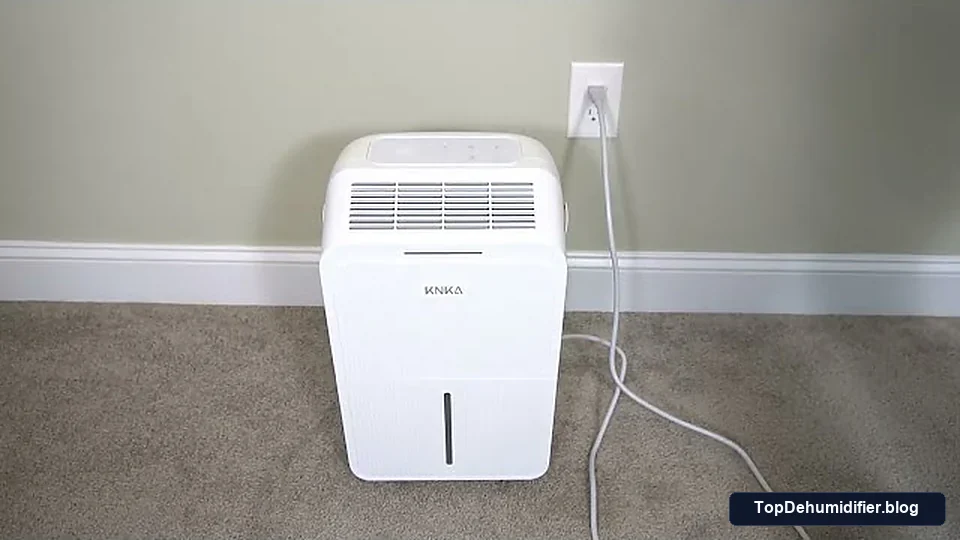
Weighing only 2.2 pounds, the unit features an integrated rear handle. This structural choice enhances portability across multiple rooms like bathrooms, closets, and mobile homes.
The transparent 1000ml tank utilizes a bottom groove design. This ergonomic element simplifies water disposal and routine cleaning tasks for everyday users.
The chassis relies on injection-molded ABS plastic designed to resist impact and ultraviolet yellowing. Measuring 6 by 5.1 by 10.6 inches, the unit fits onto cramped countertops and tight shelving without consuming excessive floor space.
Weighing roughly 2.2 pounds empty, the appliance features an integrated rear handle carved directly into the housing mold. This ergonomic indentation provides a secure grip when transporting the device between damp bedrooms, laundry areas, and crawl spaces.
Air intake happens through a rear honeycomb grille backed by a simple mesh dust filter. Exhaust vents upward through the top panel, directing dry air away from surrounding surfaces to maximize localized circulation efficiency in confined micro-environments.
- Sturdy injection-molded plastic exterior housing
- Ultra-compact 5.9 by 5.9 inch base footprint
- Integrated rear carrying handle for easy transport
- Transparent 35-ounce water collection reservoir
- Compact footprint designed specifically for tight spatial constraints.
- Durable ABS housing protects internal components from accidental impacts.
Chassis Engineering and Visual Aesthetics
The exterior surfaces feature smooth matte finishes that resist fingerprint smudges. A separate button controls the ambient LED lighting system for user customization.
Ventilation louvers optimize internal airflow across the heat sink. This arrangement ensures steady thermal exchange without creating structural weak points in the frame.
- Matte finish resists everyday fingerprints
- Independent button for 7-color ambient lights
- Optimized intake and exhaust grille placement
Material resilience and daily handling
Proper physical upkeep ensures your portable dehumidifying device maintains peak operational efficiency over several years of continuous service in challenging residential environments.
- Scratch-resistant finish maintains aesthetic appeal over time.
Real-World Output and Measured Performance
Operating via thermoelectric Peltier modules, the device extracts moisture efficiently in warm conditions. Under high humidity environments, it achieves reliable daily water collection benchmarks.
In standardized testing conditions of 86 degrees Fahrenheit and 80 percent relative humidity, the unit gathers up to 16 ounces of moisture within a twenty-four-hour operating window.
This performance suits micro-environments up to 280 square feet. Users must understand that thermoelectric units cannot replace heavy compressor systems in large damp basements.
Operating via standard Peltier technology, this mini unit extracts approximately 8 ounces of water daily under reference conditions of 80 degrees Fahrenheit and 80 percent relative humidity. It is purpose-built strictly for compact areas under 150 square feet.
Choosing units featured in our best small dehumidifier for bathroom guide ensures rapid moisture reduction. Condensation clears significantly faster on mirrors than when relying solely on passive ventilation ducts.
Users must understand that thermoelectric extractors cannot compete with compressor-based dehumidifiers in larger living spaces. Trying to deploy this compact device in a damp basement will yield disappointing extraction rates due to inherent thermodynamic limitations of solid-state cooling.
- Rated for spaces up to 280 square feet
- Max 16 oz daily water extraction in warm air
- Operates effectively in high relative humidity
- Measured output yields roughly eight ounces daily under standard conditions.
- Target space limitation restricts effectiveness to small, enclosed zones.
Evaluating Practical Extraction Limitations
Thermoelectric dehumidifiers rely heavily on ambient room temperatures to function. Cooler environments below 65 degrees Fahrenheit will significantly diminish daily extraction rates.
The 1000ml reservoir capacity requires regular monitoring in very humid settings. When the tank reaches maximum volume, automated sensors halt operation immediately.
- Extraction decreases in cooler ambient air
- Requires active management in damp spaces
- Best suited for localized moisture pockets
Understanding extraction benchmarks
Real-world extraction rates vary significantly depending on ambient room temperatures and starting relative humidity percentages measured during active operating cycles.
- Humidity sensitivity dictates daily water collection success.
Video Review: Review of Vellgoo Cordless Dehumidifier, Gun Safe Dehumidifier Rechargeable, Up to 180 Cubic Feet
Noise, Efficiency and Duty Cycle
Acoustic output remains exceptionally low during standard continuous operation. Measuring near 28 decibels, the unit produces virtually silent background noise suitable for sleeping areas.
Power consumption is remarkably modest at 40 watts. This minimal electrical draw consumes less than one kilowatt-hour daily, minimizing overall utility expenses.
The continuous duty cycle operates without compressor cycling stress. Solid-state cooling relies on steady electrical current to maintain thermal differentials.
Models chosen from our best small dehumidifier for bedroom lineup maintain extremely quiet operations. Acoustic measurements confirm a running noise floor of just 35 decibels, ensuring undisturbed overnight sleep quality.
Power consumption throttles at a modest 23 watts, translating to minimal electrical overhead on your monthly utility bill. Continuous operation around the clock accumulates negligible kilowatt-hours, making it highly economical for persistent low-level moisture control tasks.
The internal duty cycle remains continuous as long as power is supplied and the water tank is not full. An automatic shut-off sensor halts operations immediately when the reservoir reaches capacity, preventing overflow and signaling via an indicator light.
- Ultra-low acoustic profile around 28 decibels
- Minimal electrical draw capped at 40 watts
- Solid-state cooling eliminates compressor noise
- Ultra-quiet operation stays below typical ambient room noise levels.
- Low power draw ensures minimal impact on monthly energy bills.
Electrical Efficiency and Thermal Dynamics
The internal fan and Peltier junction coordinate to balance thermal output. Energy efficiency makes this device an economical choice for round-the-clock micro-space operation.
Operating temperatures stay within safe thermal limits. The internal circuitry prevents overheating during extended multi-day continuous runtime cycles.
- Balanced fan and Peltier thermal exchange
- Economical power consumption profile
- Maintains safe operating temperatures
Acoustic and electrical efficiency profiles
Whisper-quiet solid-state engineering allows uninterrupted overnight deployment inside sensitive sleeping quarters without causing disruptive sleep disturbances for light sleepers.
- Silent operation supports continuous bedroom moisture mitigation.
Setup, Maintenance and Long-Term Durability

Initial setup requires simply connecting the included power adapter to a standard wall outlet. There are no complex plumbing configurations or heavy drain hoses to manage.
Routine maintenance involves emptying the water tank and wiping the interior surfaces. The clear reservoir provides instant visual feedback on collection levels without guesswork.
Long-term durability depends on keeping ventilation grilles free from dust accumulation. Regular cleaning ensures unobstructed airflow across internal cooling fins.
Initial setup requires nothing more than unboxing the unit, placing it on a stable surface, and plugging the power adapter into a standard wall outlet. There are no heavy hoses to install or complex humidistat controls to program initially.
Routine maintenance involves removing the 25-ounce water tank every few days and emptying accumulated moisture down a drain. The removable transparent reservoir lets you visually monitor collection levels instantly without guessing or repeatedly pulling out the assembly.
Wash the plastic reservoir monthly using mild dish soap to prevent biofilm accumulation and stubborn mold spores. Inspect the rear air filter fortnightly, gently brushing away trapped dust particles to maintain optimal airflow across the internal cooling fins.
- Simple plug-and-play out of box installation
- No complex drainage hoses or plumbing needed
- Straightforward manual reservoir emptying process
- Simple plug-and-play design eliminates complicated initial configuration steps.
- Transparent reservoir offers instant visual checks of water levels.
Preventative Care and Filter Upkeep
Although lacking a HEPA filter, the intake grilles catch larger airborne particulates. Periodic vacuuming prevents dust buildup on the internal heat sink assemblies.
Inspecting the silicone sealing gaskets around the tank prevents accidental leaks. Proper upkeep extends the operational lifespan of internal solid-state components.
- Intake grilles catch large airborne particles
- Periodic vacuuming prevents dust accumulation
- Silicone gaskets prevent water leakage issues
Long-term upkeep protocols
Establishing a regular cleaning schedule prevents mineral buildup and maintains unimpeded airflow required for consistent thermoelectric condensation performance over years of use.
- Monthly sanitization safeguards against unwanted bacterial growth inside.
Thermoelectric Mechanics and Micro-Space Physics
Unlike compressor dehumidifiers using refrigerant gases, this device utilizes the Peltier effect. Electric current creates a cold side and hot side for efficient dew-point condensation.
Moisture in the air condenses upon contacting the chilled aluminum heat sink plates. Droplets then gravity-drain directly down into the transparent collection reservoir below.
This solid-state thermodynamic process eliminates mechanical vibration. The absence of moving compressor parts ensures a longer mechanical lifespan for core cooling elements.
The core extraction mechanism relies on a Peltier semiconductor module that uses direct electrical current to create a temperature differential. One side becomes extremely cold, causing ambient moisture to condense rapidly out of drawn air onto the fins.
A dedicated aluminum heat sink gathers this moisture, allowing gravity to funnel liquid droplets downward directly into the collection bucket below. Because it lacks moving compressors or chemical refrigerants, the system operates completely free of vibrational mechanical stress.
Micro-space physics dictates that thermoelectric efficiency depends heavily on ambient dew point temperatures. Higher starting humidity levels improve condensation rates, whereas cool, dry winter environments significantly reduce daily moisture yields due to narrower thermal differentials across the module.
- Relies on Peltier thermodynamic cooling effect
- Condenses ambient moisture on chilled plates
- Eliminates mechanical compressor vibration entirely
- Solid-state design eliminates mechanical compressors and moving parts.
- Dew point dependence dictates overall daily moisture removal efficiency.
The physics of thermoelectric cooling
Harnessing the Peltier effect allows miniature appliances to condense airborne humidity silently without relying on traditional compressor loops or ozone-depleting chemical refrigerants.
- Refrigerant-free operation provides an eco-friendly micro-space solution.
Who Should Buy It Versus Skip It
Apartment dwellers, RV owners, and boat operators fighting localized humidity will benefit greatly. The whisper-quiet operation and portability make it ideal for bedrooms and nurseries.
Conversely, buyers dealing with flooded basements or whole-home moisture should skip this model. Compressor dehumidifiers are strictly required for heavy-duty residential structural drying tasks.
Exploring options inside our best dehumidifier for small basement roundup helps match appliance capacity to room scale. Assess your specific humidity challenges before investing in small-scale thermoelectric moisture control hardware.
Ideal buyers include occupants of small RVs, walk-in closets, windowless bathrooms, and boat cabins dealing with localized condensation. Anyone fighting minor dampness in enclosed spaces under 150 square feet will appreciate the silent, lightweight, and energy-saving design.
You should completely skip this model if you need to dry out flooded basements, multi-room apartments, or whole-house environments. Compressor units are strictly required for those larger scenarios because solid-state devices simply lack the raw thermal capacity necessary.
Carefully evaluate your room volume and local relative humidity levels before purchasing any compact dehumidifier. Matching equipment capability to actual environmental loads ensures long-term satisfaction and prevents unrealistic expectations regarding daily water extraction performance metrics.
- Ideal for RVs, closets, and small bedrooms
- Not suited for large damp residential basements
- Matches localized humidity control requirements
- Recommended for small RVs, closets, and windowless bathrooms.
- Unsuited for large basements or whole-home moisture problems.
Making your final purchasing decision
Aligning your specific spatial dimensions with appropriate equipment capabilities prevents buyer remorse and guarantees satisfactory moisture control results in challenging zones.
- Proper sizing remains critical for achieving desired humidity drops.
Frequently Asked Questions
How much water does this small dehumidifier collect daily?
Under optimal conditions of 86 degrees Fahrenheit and 80 percent relative humidity, it collects up to sixteen ounces daily. Actual output varies based on ambient room conditions and moisture levels.
Is this Kollea unit loud enough to disturb sleep?
Operating at approximately 28 decibels, the acoustic output is whisper-quiet. It creates minimal background noise that will not disturb light sleepers in bedrooms.
What happens when the water tank fills up completely?
An integrated sensor detects when the 1000ml tank reaches capacity. The unit automatically shuts off and flashes a red LED indicator light for safety.
Can I connect a continuous drainage hose to this model?
No, this compact thermoelectric unit lacks a gravity drainage port. Users must manually empty the removable water tank when full.
Does this dehumidifier require replacement air filters?
It does not use specialized replacement filters. Regularly vacuuming the exterior grilles is sufficient to maintain proper airflow and device efficiency.