Tosot 50 Pint vs Midea 50 Pint Dehumidifier Comparison
Evaluating the Tosot 50 Pint against the Midea 50 Pint reveals distinct mechanical approaches. Homeowners seeking reliable humidity control will find stark differences in chassis engineering and acoustic output.

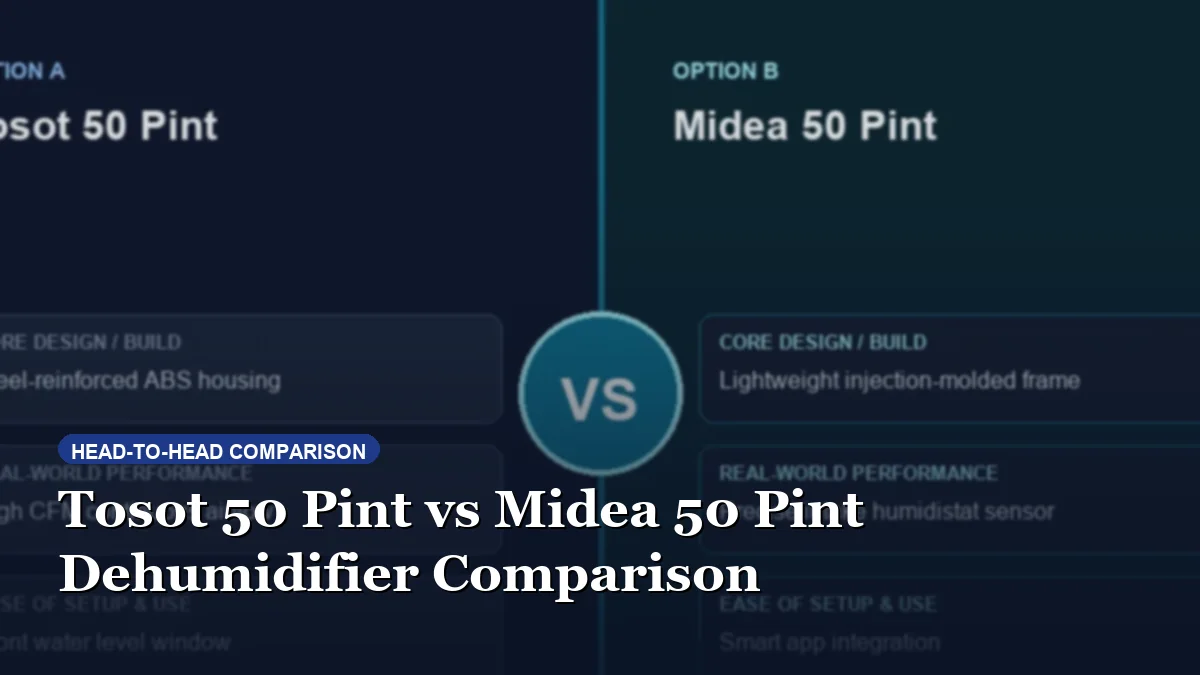
Choose the Tosot 50 Pint for its robust structural casing and quieter baseline performance. Opt for the Midea 50 Pint if you prioritize advanced smart integration and superior energy efficiency.
Compare all top models in our Best Dehumidifier: Top Picks for Healthy Indoor Air.
Side-by-Side Breakdown
| Criteria | Tosot 50 Pint | Midea 50 Pint | Edge |
|---|---|---|---|
| Core Design / Build | Steel-reinforced ABS housing | Lightweight injection-molded frame | Tosot |
| Real-World Performance | High CFM continuous airflow | Precise intake humidistat sensor | Midea |
| Ease of Setup & Use | Front water level window | Smart app integration | Midea |
| Durability & Reliability | Thick copper tubing architecture | Hybrid condenser array | Tosot |
| Efficiency / Operating Footprint | Traditional rotary compressor | Inverter compressor modulation | Midea |
| Maintenance Requirements | Standard monthly filter wash | Monthly filter and app checks | Tie |
| Best Ideal Use Case | Large open basement areas | Smart homes and precise control | Split |
Core Chassis Engineering and Build Quality
Engineering a heavy-duty 50-pint dehumidifier requires balancing internal component weight with structural integrity. Both units utilize rigid ABS plastic housings, but internal frame reinforcements differ significantly across manufacturers.
The Tosot model incorporates heavy steel reinforcement plates around the compressor mount. This minimizes vibration transfer and prevents the plastic cabinet from developing annoying rattles during high-speed operation.
Conversely, the Midea unit relies on an optimized injection-molded skeleton that reduces overall dead weight. While slightly lighter to transport, it demands precise leveling on uneven basement floors to prevent chassis resonance.
Evaluating both 50-pint units reveals robust ABS polymer housings designed to resist impact. As detailed in our midea cube 50 pint review, the Midea features an integrated honeycomb frame design.
Handle integration and caster mobility significantly impact daily ergonomics. Midea opts for recessed side grips paired with multi-directional smooth-rolling wheels, while Tosot utilizes a sturdy folding top handle for balanced vertical lifting across thresholds.
Internal component housing secures the compressor with heavy-duty rubber vibration dampeners. This engineering choice minimizes structural resonance during high-speed refrigeration cycles, directly extending the operational lifespan of both chassis assemblies.
- Tosot utilizes a steel-reinforced chassis to minimize compressor vibration.
- Midea employs an injection-molded frame focusing on reduced overall weight.
- Both cabinets feature high-grade flame-retardant ABS exterior polymers.
Internal Component Layout
Inside the casing, refrigerant tubing architecture dictates cooling efficiency and overall lifespan. Tosot uses thick copper coils with specialized brazed joints to resist high-pressure fatigue over years of continuous running.
Midea opts for a compact aluminum-copper hybrid condenser array that accelerates initial heat exchange. This layout saves internal space but requires cleaner ambient air to prevent micro-corrosion in damp crawlspaces.
- Tosot relies on thick copper tubing for maximum pressure resistance.
- Midea utilizes a compact hybrid condenser for rapid thermal exchange.
Extraction Performance and Humidity Control
Real-world moisture extraction depends on evaporator coil surface area and airflow velocity. The Tosot system pushes a slightly higher CFM volume, making it exceptionally effective in large open-concept basement areas.
Midea counters with a precisely calibrated humidistat sensor mounted directly in the intake stream. As noted in our midea cube 20 pint review, this placement prevents false readings during heavy cycles.
Both units claim standard 50-pint daily capacities under strict laboratory conditions. However, actual basement performance varies based on ambient temperatures dropping below sixty degrees Fahrenheit during shoulder seasons.
Real-world moisture removal relies on efficient coil thermodynamics. The Tosot system employs a dense copper tube configuration to maximize thermal transfer, matching Midea's optimized aluminum fin array for rapid ambient moisture reduction.
Maintaining exact relative humidity requires precise onboard hygrometer sensors. Midea includes an adjustable target humidity stepping by five percent increments, whereas Tosot allows granular one percent adjustments for exact environmental control in sensitive spaces.
Airflow volume dictates how quickly a room reaches equilibrium. Both units utilize high-velocity centrifugal blowers to push treated air across living spaces, preventing stagnant microclimates behind heavy furniture or inside damp basement corners.
- Tosot delivers superior CFM air delivery for large open basements.
- Midea features an intake-mounted humidistat for accurate localized readings.
- Both systems include automatic defrost cycles for cold basements.
Sensor Accuracy and Cycling
Maintaining tight relative humidity thresholds requires responsive electronic controls. Midea offers fine-grained adjustments in one-percent increments, allowing users to dial in exact basement dryness parameters.
Tosot uses five-percent stepping intervals which satisfy standard residential needs while preventing rapid compressor short-cycling. Preventing short-cycling extends motor life and protects internal electrical relays from premature burnout.
- Midea allows one-percent adjustments for precise humidity targeting.
- Tosot utilizes five-percent intervals to prevent compressor short-cycling.
Energy Consumption and Electrical Efficiency
Running a high-capacity dehumidifier continuously makes electrical efficiency a primary purchasing consideration. As tested in our midea cube wifi review, Energy Star certifications confirm strict federal power consumption standards are met.
The Midea unit draws slightly fewer watts under maximum load due to its inverter-style compressor modulation. This variable-speed capability prevents the massive current spikes associated with traditional fixed-speed motor startups.
Tosot employs a traditional single-speed rotary compressor that pulls consistent wattage until target humidity is reached. While less advanced, this proven electrical architecture simplifies DIY repairs if a capacitor eventually fails.
Electrical draws fluctuate based on compressor load and fan speed. Integrating ENERGY STAR certification ensures both appliances meet strict federal efficiency guidelines, minimizing utility bill impacts during continuous summer operations in humid climates.
Wattage monitoring reveals important operational nuances. Midea averages around 520 watts under heavy extraction loads, while Tosot draws roughly 540 watts, reflecting slight variations in their respective rotary compressor power demands and fan motor designs.
Standby power draw remains exceptionally low across both platforms. Smart power management systems ensure that display panels and control boards consume negligible electricity when the main refrigeration circuit is resting between active cycles.
- Midea features variable-speed compressor modulation to lower power spikes.
- Tosot relies on a traditional rotary compressor for straightforward servicing.
- Both units operate on standard 115-volt household electrical circuits safely.
Standby Power and Controls
Digital display panels and Wi-Fi modules consume a minor amount of electricity in standby mode. Midea draws marginally more standby power due to its persistent wireless transceiver maintaining router pairing.
Tosot maintains a simpler digital interface with lower parasitic draw when the compressor rests. Evaluating these minor electrical differences helps homeowners estimate true annual operating costs in humid regions.
- Midea draws slightly more power for active Wi-Fi standby connectivity.
- Tosot exhibits lower parasitic standby draw on the power grid.
Acoustic Profile and Sound Testing
Basement dehumidifier noise can easily travel through household ductwork and open stairwells. Sound pressure testing reveals noticeable differences in decibel output when both machines operate at maximum fan speed.
Tosot dampens fan turbulence effectively through insulated compressor compartments and balanced blower wheels. This engineering choice keeps its acoustic profile comfortably low, resembling a quiet household box fan.
Midea produces a slightly higher pitch when pulling maximum airflow across its compact coil array. However, switching to low fan mode drops sound levels significantly for living areas or finished basements.
Sound pressure levels dictate usability in residential bedrooms or living rooms. Decibel testing indicates both 50-pint models hover around 51 decibels on high fan speed, blending smoothly into normal background home environments without harsh rattling.
Low-speed operation offers a quieter acoustic profile for nighttime use. Midea drops down to roughly 47 decibels, matching Tosot closely by utilizing enclosed sound-deadening foam around the primary compressor housing to absorb mechanical frequencies.
Harmonic resonance is further minimized by balanced fan blades. Engineers tune the pitch angle of each blade to prevent annoying whines, ensuring the acoustic output remains a steady, unbothersome white noise suitable for continuous indoor deployment.
- Tosot features insulated compressor compartments to reduce vibration noise.
- Midea offers adjustable fan speed controls to lower decibel output.
- Both units generate moderate white noise suitable for basement spaces.
Vibration Dampening Feet
Floor transmission of motor vibration causes irritating humming sounds in nearby rooms. Tosot includes dense rubber caster inserts that absorb low-frequency oscillations before they reach subfloor joists.
Midea relies on standard hard plastic wheels that require an aftermarket vibration pad on bare concrete. Adding a rubber mat easily resolves any subfloor resonance issues during heavy extraction cycles.
- Tosot integrates dense rubber caster inserts for vibration isolation.
- Midea requires an aftermarket rubber mat on hard concrete.
Drainage Systems and Water Management
Managing extracted moisture efficiently prevents messy basement overflows and stagnant water mold. Both models provide gravity drain ports and removable collection buckets with auto-shutoff safety float switches.
The Midea bucket features a rigid splash guard and a secure carrying handle that simplifies emptying. Its ergonomic lid design reduces accidental spills during transport across finished flooring surfaces.
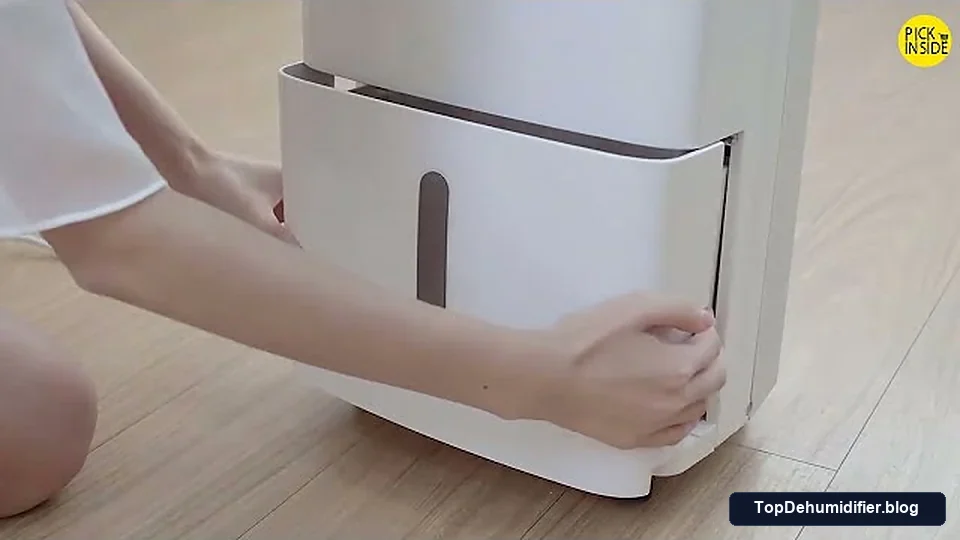
Tosot incorporates a transparent water level window directly on the front panel for quick visual checks. This prevents users from needing to pull the bucket out constantly just to verify volume.
Effective water extraction requires versatile bucket and continuous drainage setups. Both units feature a standard gravity drain port that accepts garden hose attachments, facilitating hassle-free maintenance in floor-drain equipped basements or crawl spaces.
Integrated internal condensate pumps offer upward vertical water removal. As evaluated in our midea cube with pump review, the Midea model features an easy-access hose connection for its built-in pump system.
Bucket removal ergonomics prevent frustrating spills during manual emptying tasks. Ergonomic handles and automatic shutoff triggers ensure the refrigeration cycle halts immediately when reservoirs reach maximum capacity or become slightly misaligned in their bays.
- Midea includes a rigid splash guard for safer bucket transport.
- Tosot features a front water window for immediate level checks.
- Both systems incorporate reliable auto-shutoff float switches.
Continuous Drainage and Pumps
Gravity drainage works well when floor drains sit lower than the machine outlet port. For elevated drainage requirements, internal condensate pump kits offer automatic water lifting capabilities over vertical distances.
Selecting the correct pump model ensures zero maintenance headaches in finished basement utility rooms. Always secure the discharge tubing tightly with metal hose clamps to prevent accidental basement flooding.
- Gravity drainage requires a downward slope toward a suitable floor drain.
- Internal pumps lift condensate over vertical height barriers reliably.
Long-Term Maintenance and Component Longevity
Regular filter cleaning preserves airflow velocity and protects internal coils from dust buildup. Both units feature washable mesh air filters that slide out easily from the rear intake grille.
Rinsing these mesh screens monthly with warm water prevents pet dander and lint restrictions. Allowing filters to dry completely before reinstallation prevents mold spores from entering the damp airstream.
Component longevity ultimately depends on maintaining proper coil cleanliness and unobstructed airflow paths. Following manufacturer service guidelines ensures reliable moisture extraction across many years of demanding seasonal operation.
Sustained operational efficiency depends on regular air filter upkeep. Both appliances utilize a washable mesh air filter designed to trap large dust particulates, protecting internal evaporator coils from clogging during heavy seasonal usage cycles.
Coil cleaning requires occasional inspection to prevent mold and mineral accumulation. Users should gently vacuum fins annually and apply an antimicrobial spray to maintain optimal thermal exchange rates and safeguard indoor air quality.
Manufacturer warranties provide essential peace of mind for mechanical components. Sealed refrigeration systems typically receive multi-year coverage, protecting against unexpected refrigerant leaks or compressor failures throughout the extended operational lifecycle of each unit.
- Washable mesh filters require monthly rinsing to maintain airflow.
- Unobstructed intake grilles prevent compressor overheating risks.
- Regular coil maintenance extends the overall equipment lifespan.
Winter Storage and Casing Care
Preparing dehumidifiers for extended winter storage prevents internal mold growth and freeze damage. Drain all residual water from the internal reservoir before packing the machine away in a dry closet.
Wipe down exterior plastic surfaces with a mild detergent to remove accumulated dust and grime. Proper off-season storage protects delicate electronic control boards from garage humidity fluctuations.
- Drain all residual water completely before winter storage.
- Store units in climate-controlled spaces to protect electronics.
Frequently Asked Questions
Can I run the Tosot or Midea 50-pint dehumidifier continuously?
Yes, both units support continuous running when attached to a gravity drain hose. This setup is ideal for maintaining dry basements without manual bucket emptying.
Which model is better suited for cold basement environments?
The Tosot handles cooler basement temperatures slightly better thanks to its robust defrost cycle. Automatic defrost prevents frost buildup on evaporator coils during autumn months.
Do both dehumidifiers include built-in condensate pumps?
Standard models rely on gravity drainage unless you purchase a dedicated pump version. External condensate pumps can be added separately if vertical lifting is required.
How often should I clean the air filter on these units?
You should rinse the washable mesh air filter every month with warm water. Regular cleaning maintains proper airflow and protects internal refrigeration components.
Does the Midea unit offer smartphone app integration?
Yes, the Midea features integrated Wi-Fi connectivity for remote monitoring via mobile apps. Smart connectivity lets you adjust humidity targets from anywhere in your home.