Thermoelectric vs Compressor Dehumidifier Guide
Choosing the right moisture control device requires understanding core cooling and extraction mechanics. We evaluate engineering footprints, daily yields, and operating longevity.

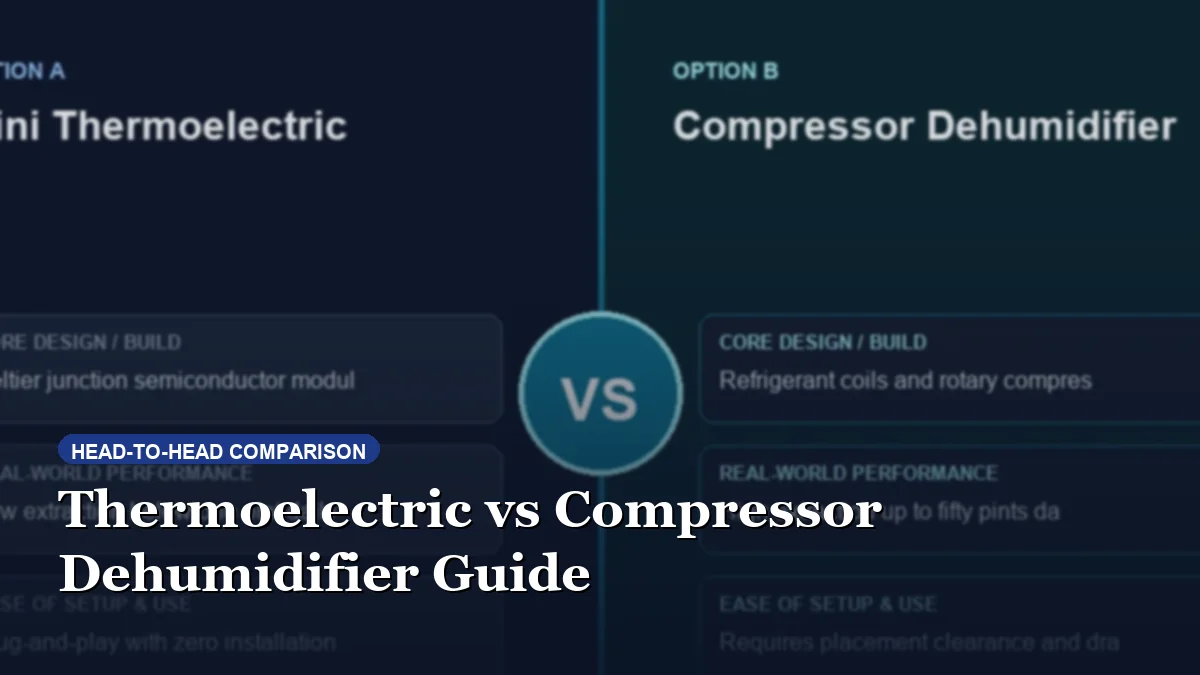
Choose mini thermoelectric units for tiny enclosed spaces like gun safes and RV closets. Select compressor dehumidifiers for whole-room humidity reduction and high-capacity daily water removal.
Compare all top models in our Best Dehumidifier: Top Picks for Healthy Indoor Air.
Side-by-Side Breakdown
| Criteria | Mini Thermoelectric | Compressor Dehumidifier | Edge |
|---|---|---|---|
| Core Design / Build | Peltier junction semiconductor modules | Refrigerant coils and rotary compressors | Compressor Dehumidifier |
| Real-World Performance | Low extraction below one pint daily | High extraction up to fifty pints daily | Compressor Dehumidifier |
| Ease of Setup & Use | Plug-and-play with zero installation | Requires placement clearance and drainage | Mini Thermoelectric |
| Durability & Reliability | Fewer moving parts for longevity | Mechanical compressor wear over time | Mini Thermoelectric |
| Efficiency / Operating Footprint | Low wattage drawing under fifty watts | Higher wattage drawing several hundred watts | Mini Thermoelectric |
| Maintenance Requirements | Basic tank emptying and surface dusting | Filter washing and continuous hose management | Mini Thermoelectric |
| Best Ideal Use Case | Compact lockers and small micro-spaces | Basements, laundry rooms, and living areas | Compressor Dehumidifier |
Core Design & Engineering Differences
Understanding internal architecture is vital when comparing these moisture removal systems. Peltier modules rely on solid-state thermoelectric physics without utilizing harmful greenhouse refrigerants or heavy mechanical pumps.
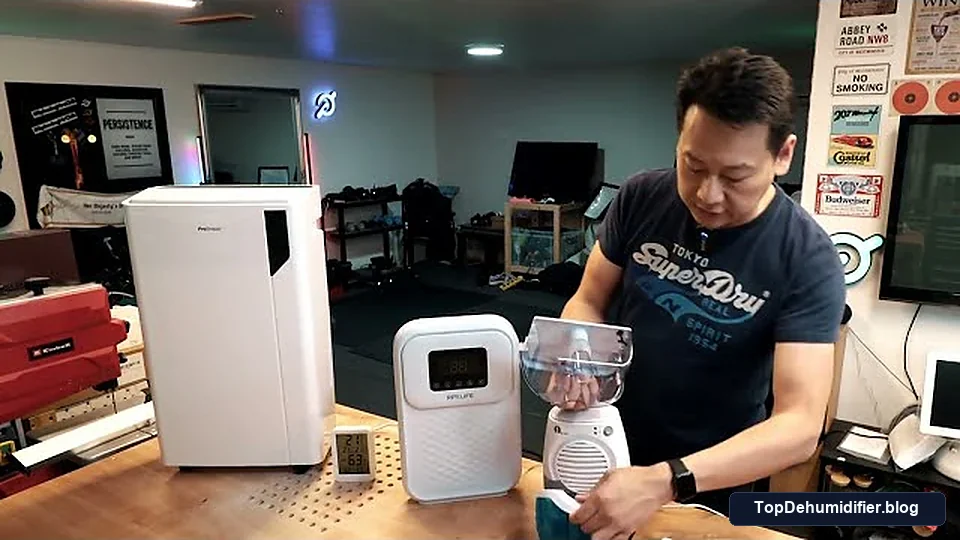
Unlike the low-capacity systems detailed in our eva dry e 500 review, compressor units function identically to household refrigerators, utilizing a motorized compressor alongside evaporator coils.
Compressor models rely on a sealed refrigerant circuit utilizing a compressor, condenser, and evaporator coil to rapidly chill air and condense moisture. This robust thermodynamic design handles heavy loads.
Conversely, thermoelectric units deploy the Peltier effect, passing direct current through semiconductor modules to create a cold side for condensation and a hot side for heat dissipation.
- Solid-state design eliminates compressors and moving pistons entirely.
- Refrigerant systems require pressurized copper tubing and complex chemical cycles.
- Weight discrepancies stem from heavy internal copper coils and motors.
Solid-State vs Refrigeration Mechanics
Thermoelectric devices pass electrical current through two dissimilar conductors. This creates a hot side and a cold side, causing moisture to condense instantly onto an aluminum heat sink.
Compressor systems draw humid air across sub-cooled evaporator coils using a fan. The dramatic temperature differential forces moisture to drop rapidly into a collection bucket.
- Solid-state engineering offers absolute silent operation.
- Refrigeration engineering delivers superior thermodynamic efficiency.
Real-World Performance & Extraction Rates
Daily water removal capacity separates these two technologies dramatically, matching findings from our pro breeze mini dehumidifier review. These thermoelectric units extract less than one pint daily.
Compressor models excel in damp environments by pulling anywhere from thirty to fifty pints daily. They actively transform humid rooms into comfortable living spaces within hours.
Standard compressor systems routinely extract pints of water daily, making them ideal for damp basements, crawlspaces, and whole-room humidity control during humid summer months.
Miniature Peltier devices typically yield only ounces per day, restricting their operational capacity to small, enclosed spaces like gun safes, instrument cases, or tiny RV closets.
- Small Peltier units struggle in spaces exceeding one hundred square feet.
- Compressor units maintain low relative humidity across entire basements.
Capacity Limits in Damp Spaces
Testing reveals that semiconductor dehumidifiers lose effectiveness rapidly when ambient temperatures drop. Their extraction limits make them completely unsuitable for unheated subterranean spaces.
Heavy-duty compressor appliances maintain high performance across varied temperature ranges. They remain the undisputed champions for managing persistent household mold and moisture.
- Low extraction limits restrict Peltier units to micro-environments.
- High extraction volumes prevent structural moisture damage effectively.
Maintenance, Efficiency & Longevity
Operational efficiency impacts your monthly utility bill significantly. Low wattage draw makes semiconductor units cheap to run, though their low output limits their overall utility.
Compressor models consume more electricity due to motor operation, a factor tied to risks covered in our compressor failure guide. Their high extraction rate ensures shorter run times.
Refrigerant-based units demand periodic coil cleaning and filter washing to maintain heat transfer efficiency, while compressor mechanical wear eventually limits the overall operational lifespan to several years.
Thermoelectric devices feature no moving parts except a small cooling fan, significantly reducing mechanical failure rates and simplifying long-term upkeep for users seeking low-maintenance appliances.
- Thermoelectric systems feature minimal internal components prone to mechanical failure.
- Compressor units require periodic coil cleaning and filter washing.
Long-Term Reliability Factors
Solid-state units boast exceptional lifespan reliability because they lack vibrating motors. Fewer moving parts translate directly into years of trouble-free operation in small spaces.
Compressor motors experience normal mechanical wear over extended deployment periods. Proper maintenance, including regular air filter cleaning, extends compressor longevity considerably.
- Solid-state appliances resist mechanical breakdown effectively.
- Refrigerant loops require sealed integrity over decades.
Acoustic Profiles & Vibration Management
Noise output dictates where you can comfortably place your device, a factor tested in our eva dry e 333 review. Whisper-quiet fans allow bedroom placement without disruption.
Compressor appliances generate noticeable hums and mechanical vibrations. Sound dampening feet and solid flooring are frequently necessary to keep operating noise manageable.
Rotary compressors generate noticeable mechanical hum and structural vibration, requiring rubber isolation feet or sound dampening mats to prevent disruptive noise transmission across flooring.
Peltier dehumidifiers operate almost silently, producing only a faint fan whir, which makes them exceptional for quiet bedrooms, nurseries, and sensitive home office recording environments.
- Thermoelectric devices produce only minimal ambient fan sound.
- Compressor motors generate noticeable low-frequency hums during cycles.
Acoustic Impact on Living Spaces
If you require absolute silence near sleeping quarters, semiconductor units win easily. Their lack of a mechanical compressor ensures uninterrupted quiet throughout the night.
Living rooms and basements easily absorb the standard operational noise of a compressor. The trade-off is completely justified by massive daily moisture extraction.
- Quiet operation suits small enclosed study areas.
- Industrial hum requires isolated basement placement.
Climate Sensitivity & Operational Limits
Environmental conditions dictate how efficiently each technology performs indoors. Ambient temperature thresholds heavily influence semiconductor condensation rates and overall system output.
Compressor models operate reliably across standard residential climates. They feature built-in defrost cycles to prevent frost accumulation on evaporator coils during cooler months.
Compressor efficiency drops sharply in cold environments, risking evaporator coil freezing unless the unit features an automatic defrost cycle for winter basement operation.
Solid-state thermoelectric units struggle with ambient heat rejection, performing poorly in warm, humid spaces because their heat sink cannot dissipate thermal energy effectively.
- Peltier units fail to gather moisture in unheated winter rooms.
- Compressor units handle humid summer conditions with superior efficacy.
Temperature and Humidity Boundaries
Semiconductor surfaces require specific thermal differentials to pull moisture effectively. When room temperatures drop below standard thresholds, water extraction halts almost entirely.
Refrigeration cycles thrive in warm, humid environments where moisture is abundant. Their operational bandwidth matches typical residential humidity challenges.
- Thermal limits restrict mini units to climate-controlled rooms.
- Refrigeration adapts well to seasonal humidity fluctuations.
Which Option Fits Your Setup
Selecting the correct appliance depends entirely on your specific spatial constraints. Enclosed micro-spaces like gun cabinets or instrument cases benefit immensely from compact semiconductor devices.
Whole-room humidity control demands the raw power of a traditional compressor. Basements, laundry rooms, and crawlspaces require high-capacity extraction to prevent structural water damage.
Choose a heavy-duty compressor system if you need to remediate structural moisture issues, large living areas, or chronic dampness exceeding standard residential thresholds.
Select a miniature thermoelectric unit exclusively for targeted humidity control inside micro-environments where absolute silence, low wattage, and a negligible physical footprint matter most.
- Match mini units to small, poorly ventilated closets.
- Deploy compressor units for large, damp living areas.
Tailoring Choice to Application
Evaluate your room square footage before purchasing any moisture control equipment. Undersized units will run continuously without lowering relative humidity levels noticeably.
Prioritize drainage options when selecting high-capacity compressor appliances for remote basements. Continuous hose gravity drainage eliminates the chore of frequent bucket emptying.
- Calculate exact square footage to determine required capacity.
- Consider continuous drainage for unattended basement installations.
Frequently Asked Questions
Can a mini thermoelectric dehumidifier dry out a damp basement?
No, their low extraction rate cannot handle large underground spaces. You must use a compressor dehumidifier for basements.
Why do compressor models make more noise than mini units?
Compressor appliances rely on motorized pumps and fans. This mechanical operation creates a low-frequency hum absent in solid-state devices.
Are mini thermoelectric dehumidifiers energy efficient to run continuously?
Yes, they draw very little electricity compared to heavy motors. However, their low water extraction limits their overall usefulness.
Do compressor dehumidifiers require special installation or maintenance?
They require level placement and routine air filter cleaning. Using a drainage hose helps avoid manual bucket emptying chores.
What is the best environment for a solid-state dehumidifier?
They excel inside small, enclosed micro-environments. Use them primarily within gun safes, RV cabinets, and small walk-in closets.