Thermoelectric vs Compressor Dehumidifiers: The Technical Verdict
Choosing between a thermoelectric and a compressor dehumidifier requires understanding fundamental moisture extraction physics. This technical guide compares their operational mechanics, extraction rates, and efficiency profiles.

Choose thermoelectric units for ultra-quiet operation in compact spaces. Select compressor models for heavy-duty moisture removal in basements and living areas.
Compare all top models in our Best Dehumidifier: Top Picks for Healthy Indoor Air.
Side-by-Side Breakdown
| Criteria | Dehumidifier Thermoelectric | Compressor | Edge |
|---|---|---|---|
| Core Design / Build | Solid-state Peltier semiconductor junctions | Closed-loop refrigerant compressor system | Compressor |
| Real-World Performance | Low daily extraction yields | High volume water removal capacity | Compressor |
| Ease of Setup & Use | Lightweight plug-and-play desktop units | Heavier units requiring careful placement | Thermoelectric |
| Durability & Reliability | Fewer moving parts for longevity | Mechanical wear on moving motors | Thermoelectric |
| Efficiency / Operating Footprint | Low power draw with poor output ratio | Higher wattage with superior output | Compressor |
| Maintenance Requirements | Basic dust cleaning on intake grilles | Regular filter washing and coil checks | Thermoelectric |
| Best Ideal Use Case | Small closets, gun safes, and RVs | Basements, crawlspaces, and large rooms | Compressor |
Core Operating Mechanics and Heat Pump Physics
Compressor units utilize a closed-loop refrigeration cycle involving a compressor, condenser, and evaporator coils. This traditional thermodynamic design rapidly drops coil temperatures to condense ambient moisture efficiently.
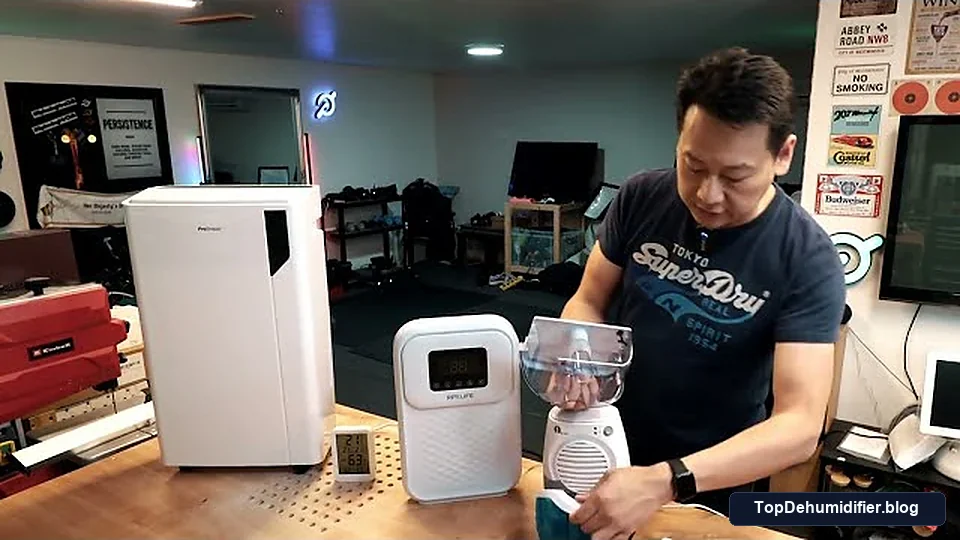
Thermoelectric models rely on the Peltier effect, passing electrical current across dissimilar semiconductor materials. This creates a hot side and a cold side without using moving mechanical compressors.
Compressor units rely on a vapor-compression refrigeration cycle using R-32 refrigerant. Monitoring system operations helps catch early signs of compressor failure before extraction drops.
Conversely, thermoelectric models utilize the Peltier effect across semiconductor junctions. Direct current drives heat transfer from one side to the other, cooling the ceramic cold plate to condense moisture without moving mechanical parts.
- Compressors use pressurized refrigerant gas loops.
- Thermoelectric devices utilize solid-state electronic cooling modules.
- Phase-change cooling delivers vastly superior thermal transfer rates.
Thermodynamic Differences in Dehumidification
The fundamental contrast lies in phase-change refrigeration versus solid-state electronic cooling. Compressor systems manipulate refrigerant pressures while thermoelectric devices transfer thermal energy directly through solid-state junctions.
- Refrigerant cycles handle large latent heat loads.
- Solid-state modules manage low heat flux environments.
Moisture Extraction Rates and Ambient Temperature Sensitivity
Standard compressor dehumidifiers extract large water volumes daily, typically ranging from thirty to seventy pints. Reviewing temperature limits for compressor dehumidifiers ensures efficient operation across moderate to warm environments.
Thermoelectric dehumidifiers extract significantly less water, often limited to a few ounces daily. Their performance drops drastically when ambient temperatures fall below sixty degrees Fahrenheit.
Refrigerant compressors easily extract 30 to 50 pints per day in standard residential spaces. They maintain high efficiency down to roughly 65 degrees Fahrenheit before frost accumulation triggers automatic defrost cycles.
Thermoelectric devices struggle with volumetric capacity, typically yielding just 1 pint daily. Their efficiency plummets drastically below 70 degrees Fahrenheit, rendering them completely ineffective in unheated basements or chilly crawlspaces.
- Compressors maintain high yields in warm basements.
- Thermoelectric output drops sharply in cool conditions.
- Daily pint ratings highlight massive capacity gaps.
Environmental Impact on Yield and Capacity
Relative humidity levels dictate how effectively each technology performs in residential spaces. Compressors thrive in humid basements, whereas thermoelectric units struggle to make an impact in large damp rooms.
- High relative humidity heavily favors compressor operation.
- Low capacity limits thermoelectric use to tiny enclosures.
Energy Consumption and Power Efficiency Metrics
Compressor dehumidifiers draw substantial electrical wattage due to heavy-duty motor and compressor operations. However, their high extraction per watt makes them energetically efficient overall.
Thermoelectric units consume very little electricity because they lack heavy motors or compressors. Despite low power draw, their low water removal yields result in poor overall efficiency.
Standard compressor dehumidifiers demand 300 to 700 watts of electrical power to run internal components. Proper diagnosing compressor and fan cycles helps maintain a favorable energy factor measured in liters per kilowatt-hour.
Peltier-based appliances consume a modest 40 to 70 watts continuously. Despite low electrical draw, their terrible extraction rate makes them far less efficient per pint of water removed than modern compressor systems.
- Compressors demand higher continuous electrical wattage.
- Thermoelectric devices draw minimal amperage during cycles.
- Water removal per watt favors traditional compressors.
Wattage Versus Output Analysis
Evaluating energy efficiency requires comparing power input against actual water removal output ratios. Compressors deliver superior moisture reduction per watt, making them ideal for continuous operation.
- Energy factor ratings highlight compressor superiority.
- Low output diminishes thermoelectric efficiency gains.
Acoustic Footprint and Mechanical Vibration Profiles
Compressor dehumidifiers generate notable operational noise from spinning fans and internal compressor motors. Sound dampening and rubber feet help reduce distracting mechanical vibrations.
Thermoelectric dehumidifiers operate almost silently, relying solely on a small DC cooling fan. This makes them exceptionally popular for quiet bedrooms and offices.
Compressor assemblies generate noticeable operating noise, often registering 50 to 55 decibels. Rotary compressors create mechanical vibrations that require rubber dampening feet to prevent resonant humming against hard flooring surfaces.
Thermoelectric units operate almost silently, producing only a soft airflow hum around 35 to 40 decibels. The complete absence of reciprocating compressors or heavy motors eliminates structural vibration entirely for bedrooms.
- Compressors produce noticeable low-frequency operational hums.
- Thermoelectric units feature near-silent solid-state operation.
- Fan noise is the primary sound source for semiconductors.
Sound Level Considerations in Living Spaces
Decibel ratings for thermoelectric models usually hover near whisper-quiet thresholds. Conversely, compressor units produce noticeable hums that require careful placement in habitable living areas.
- Bedrooms require whisper-quiet thermoelectric units.
- Basement placement isolates compressor noise effectively.
Physical Footprint, Ergonomics, and Tank Capacity
Compressor units are physically bulky and heavy, often requiring caster wheels for safe mobility. Their larger internal frames accommodate generous water collection reservoirs.
Thermoelectric dehumidifiers feature lightweight, compact housings designed for desktop or floor placement. Their diminutive size inherently limits internal drainage tank volumes.
Compressor models feature heavy chassis weighing 30 to 45 pounds, necessitating caster wheels and recessed side handles. Their large internal reservoirs accommodate 15 to 25 pints before requiring manual emptying.
Thermoelectric units are compact, lightweight appliances typically weighing under 10 pounds. Their tiny collection buckets hold barely 2 to 4 pints, requiring frequent maintenance in moderately humid environments.
- Compressors require dedicated floor space and wheels.
- Thermoelectric models fit easily inside tight cabinets.
- Tank emptying frequencies differ significantly between designs.
Portability and Condensate Management
Managing condensate requires evaluating available space and continuous drainage capabilities. Compressors offer robust gravity-drain options, while thermoelectric units demand frequent manual emptying.
- Gravity hose hookups are standard on compressors.
- Small basins require constant attention on thermoelectric units.
Durability, Lifespan, and Maintenance Requirements
Compressor systems contain sealed refrigerant loops and mechanical parts prone to mechanical wear over time. Proper coil cleaning ensures extended operational lifespans.
Thermoelectric units feature fewer moving parts, reducing mechanical failure risks significantly. Solid-state design translates to exceptional reliability in controlled environment applications.
Compressor systems offer robust operational lifespans spanning 5 to 8 years under regular residential conditions. When evaluating upgrades, checking our top-rated home dehumidifiers highlights reliable models featuring extended warranty protection.
Solid-state thermoelectric devices have virtually zero moving parts, resulting in exceptional baseline longevity for internal electronics. Maintenance is minimal, restricted primarily to dusting intake vents and cleaning small water basins.
- Compressors involve complex mechanical refrigerant loops.
- Thermoelectric units rely on durable solid-state chips.
- Maintenance routines protect internal components from failure.
Long-Term Reliability and Upkeep
Maintenance for compressors involves periodic filter washing and coil inspection. Thermoelectric devices require minimal upkeep beyond basic dust removal from intake cooling grilles.
- Air filters need regular washing on compressors.
- Dust buildup poses minimal threat to solid units.
Ideal Application Scenarios and Environmental Matching
Selecting the right dehumidifier depends entirely on spatial volume and localized humidity challenges. Basements, crawlspaces, and large rooms demand the power of compressors.
Closets, gun safes, small RVs, and personal workspaces benefit from quiet thermoelectric operation. Matching device capability to space prevents frustrating moisture control failures.
Deploy compressor dehumidifiers in large, damp areas like unfinished basements or open-concept main levels. These heavy-duty environments demand rapid moisture removal to prevent structural mold growth and warped wood framing.
Reserve thermoelectric models strictly for enclosed micro-environments like gun safes, RV cabinets, or small walk-in closets. They excel where space is severely restricted and ambient temperatures remain consistently warm.
- Large areas require high-capacity compressor units.
- Enclosed micro-spaces suit thermoelectric devices perfectly.
- Environmental matching prevents equipment overload issues.
Matching Specifications to Room Sizes
Assessing room size and baseline humidity levels prevents costly purchasing mistakes. Always prioritize technical capacity over physical size to ensure lasting indoor humidity control.
- Square footage calculations guide equipment choices.
- Humidity levels determine required extraction rates.
Frequently Asked Questions
Can a thermoelectric dehumidifier dry out a flooded basement?
No, thermoelectric dehumidifiers completely lack the heavy extraction capacity needed for large rooms and high moisture loads found in typical residential homes today.
Therefore, property owners must always invest in powerful compressor systems to properly manage severe basement and crawlspace humidity across all damp building foundations without encountering unexpected performance drops.
Why do thermoelectric units struggle in cold rooms?
Thermoelectric models rely on temperature differentials across semiconductor chips that fail when ambient air drops below specific thermal thresholds. Users must select traditional compressor systems if operating in unheated areas where temperatures routinely fall below sixty degrees Fahrenheit.
Are compressor dehumidifiers too loud for bedrooms?
Yes, standard compressor units generate noticeable mechanical vibration and fan noise that can easily disrupt light sleep patterns during nighttime operation. Individuals sensitive to ambient noise should choose ultra-quiet thermoelectric models specifically designed for quiet sleeping quarters.
Which type consumes less electricity overall?
Thermoelectric units draw very few watts due to their simple solid-state design lacking heavy motors. However, compressors deliver superior moisture removal per watt, making them energy efficient relative to their immense daily water extraction output.
Do thermoelectric dehumidifiers require special maintenance?
No, solid-state dehumidifiers have virtually no moving parts aside from a small cooling fan requiring minimal upkeep. Owners only need to clear occasional dust buildup from intake vents to maintain optimal airflow and reliable everyday operation.