115V vs 230V Commercial Dehumidifier: Technical Verdict
Choosing the right voltage rating determines your moisture removal capacity and electrical installation costs. Understanding power draws prevents costly site modifications during high-stakes restoration jobs.

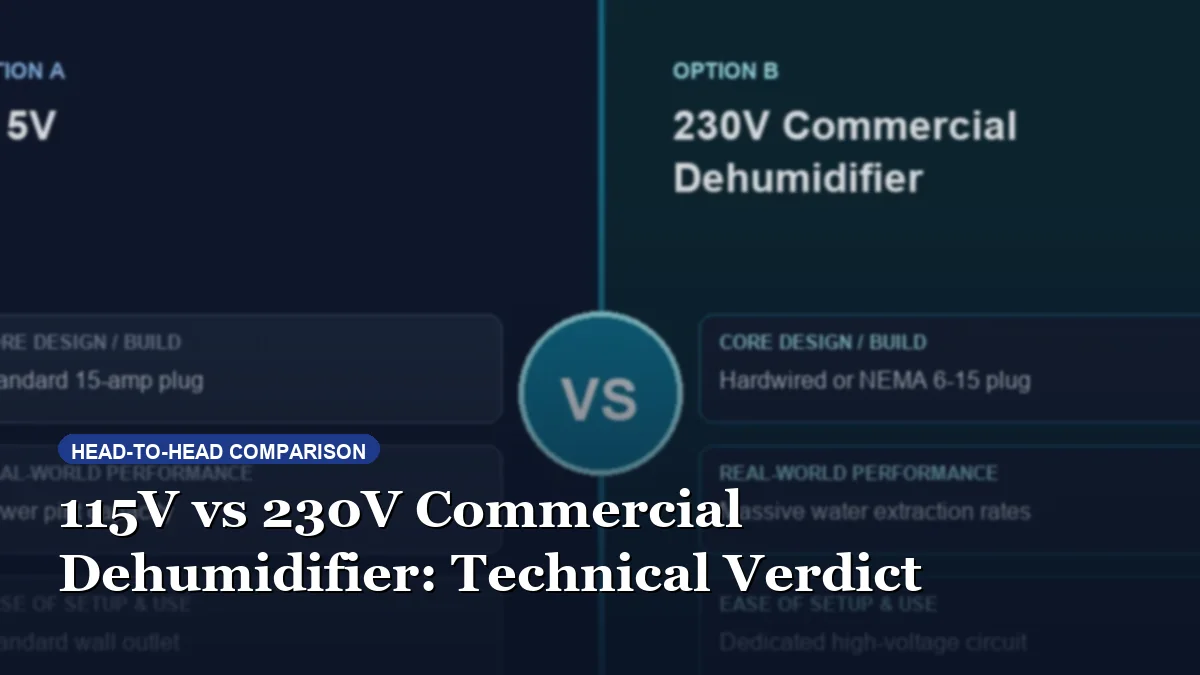
Choose the 115V model for mobile restoration and standard commercial spaces requiring flexible plug-and-play operation. Opt for the 230V unit when tackling massive permanent installations requiring continuous high-volume extraction.
Compare all top models in our Best Dehumidifier: Top Picks for Healthy Indoor Air.
Side-by-Side Breakdown
| Criteria | 115V | 230V Commercial Dehumidifier | Edge |
|---|---|---|---|
| Core Design / Build | Standard 15-amp plug | Hardwired or NEMA 6-15 plug | Tie |
| Real-World Performance | Lower pint capacity | Massive water extraction rates | 230V |
| Ease of Setup & Use | Standard wall outlet | Dedicated high-voltage circuit | 115V |
| Durability & Reliability | Rugged rotomolded housing | Heavy-duty industrial chassis | 230V |
| Efficiency / Operating Footprint | Moderate draw | High amperage efficiency | 230V |
| Maintenance Requirements | Standard filter cleaning | Comprehensive electrical checks | 115V |
| Best Ideal Use Case | Water damage restoration | Large industrial warehouses | Depends on Scale |
Core Design and Electrical Engineering
Standard commercial units operate on 115V circuits designed for universal compatibility across diverse job sites. This voltage level limits maximum compressor displacement to prevent standard circuit breakers from instantly tripping.

Heavy-duty alternatives utilize 230V configurations to deliver substantially higher mechanical power outputs. By doubling the voltage, these systems draw lower amperage while driving much larger rotary or scroll compressors.
Standard 115v commercial units rely on single-phase compressors and standard internal wiring configurations. For a practical evaluation of smaller capacities, read our Waykar 70 pint commercial dehumidifier review before purchasing.
Conversely, 230v industrial systems utilize higher voltage architectures to reduce overall current draw, significantly lowering internal thermal stress across heavy-duty compressor windings and extending primary electrical component operational life.
- NEMA 5-15 plugs for standard 115V outlets.
- Higher amp draws on low-voltage compressors.
- Dedicated breakers mandatory for 230V setups.
Voltage Architecture Differences
Electrical engineers design lower-voltage chassis for mobile contractors needing quick deployment without special wiring. Higher-voltage platforms demand permanent infrastructure upgrades to handle continuous industrial loads safely.
Internal wiring harnesses must be rated for specific thermal tolerances dictated by the input voltage. Thicker copper windings inside 230V motors minimize resistance losses during extended runtime cycles.
- Thicker gauge wiring for high loads.
- Reduced thermal output in high voltage.
Real-World Extraction Performance
Water extraction capacity directly correlates with compressor size and refrigerant mass flow rates. Standard lower-voltage units typically extract between one hundred to one hundred fifty pints daily under AHAM conditions.
Industrial high-voltage systems easily surpass two hundred pints per day by utilizing dual-evaporator coils. These high-capacity configurations maintain aggressive moisture removal rates even in cooler, low-temperature environments.
Operating in severe flood restoration jobs requires massive latent heat removal, where 230v units consistently outperform smaller models by driving higher refrigerant mass flow rates through expansive evaporator coils.
While 115v dehumidifiers handle standard office spaces efficiently, they quickly reach volumetric saturation thresholds when deployed in subterranean commercial basements demanding continuous, high-capacity moisture extraction cycles.
- AHAM rating variations across voltages.
- Lower evaporator freeze risk at 230V.
Environmental Load Capacity
Humid warehouses and flooded basements present extreme latent heat loads that challenge standard equipment limits. High-voltage units maintain optimal suction pressures when handling massive initial moisture volumes.
Smaller units struggle to maintain low relative humidity levels in spaces exceeding ten thousand cubic feet. Scaling up to a heavy-duty chassis prevents lingering structural dampness effectively.
- Superior performance in large spaces.
- Better handling of extreme latent loads.
Installation and Circuit Requirements
Deploying standard lower-voltage equipment involves plugging directly into existing wall receptacles without pre-inspection. Facility managers must verify that the shared circuit does not power other heavy heating appliances simultaneously.
Installing a 230V commercial dehumidifier requires an electrician to run dedicated wiring and install specialized receptacles. For more options, consult our best commercial dehumidifier for basement roundup to ensure proper sizing.
Facility managers must evaluate existing infrastructure before deploying hardwired 230v systems, as these heavy-duty dehumidifiers require dedicated electrical lines, specialized twist-lock plugs, and custom breaker panel upgrades.
Standard 115v plug-and-play units provide exceptional deployment flexibility, connecting directly into conventional NEMA 5-15 receptacles without requiring expensive electrician intervention or specialized facility permit processes.
- Plug-and-play simplicity for lower voltage.
- Professional electrical installation required for 230V.
Site Preparation Protocols
Assessing local panel capacity prevents unexpected power failures during peak operational hours in commercial facilities. Technicians should calculate total branch circuit loads before positioning large moisture extraction systems indoors.
- Panel capacity verification steps.
- Total branch circuit load calculation.
Energy Efficiency and Operating Costs
Energy consumption is a critical factor for facilities running climate control equipment twenty-four hours daily. Operating at higher voltages generally improves electrical efficiency by reducing resistive heat losses across internal components.
Standard units draw higher current loads which can cause minor voltage drops over long extension cords. Using heavy-gauge cords mitigates efficiency losses when deploying mobile 115V systems on remote job sites.
Calculating long-term operational energy efficiency involves analyzing moisture removed per kilowatt-hour, where higher voltage units frequently deliver superior performance ratios under sustained heavy industrial workloads.
Although 115v commercial models draw lower starting amperage, running multiple units simultaneously to match the output of a single 230v machine often increases total monthly power consumption.
- Lower current draw at higher voltages.
- Extension cord voltage drop risks.
Long-Term Power Consumption
Calculating kilowatt-hour usage helps facility managers forecast monthly utility expenses associated with continuous dehumidification. Industrial models often feature high-efficiency blowers that lower overall energy intensity ratios.
- Kilowatt-hour forecasting methods.
- High-efficiency blower integration.
Durability and Structural Ergonomics
Commercial environments demand rugged construction materials capable of withstanding rough transport and daily job site abuse. Manufacturers typically employ rotomolded polyethylene shells to protect sensitive internal refrigeration components.
High-voltage systems often incorporate heavy steel framing to support larger compressors and dual condenser coils securely. These robust chassis designs increase total equipment weight, requiring specialized handling equipment for relocation.
Heavy-gauge rotationally molded polyethylene housings protect industrial dehumidifier frames against severe impact damage and chemical corrosion. We recommend reviewing our best commercial dehumidifier for water damage guide when choosing structural drying gear.
Integrated heavy-duty caster wheels and balanced telescoping handles ensure that large capacity units remain maneuverable despite carrying dense internal compressors, heavy copper coils, and robust structural steel bracing.
- Rotomolded shells for mobile units.
- Heavy steel framing for stationary models.
Portability Versus Stationary Build
Lighter lower-voltage extractors feature integrated wheels and telescoping handles for effortless single-person loading into service vehicles. Stationary high-voltage units rely on rigid mounting feet designed for permanent floor positioning.
- Integrated wheels for easy transport.
- Rigid mounting feet for stationary setups.
Maintenance and Component Longevity
Routine upkeep ensures consistent moisture removal performance and extends the operational lifespan of commercial equipment significantly. Technicians must inspect washable air filters weekly to prevent airflow restrictions across evaporator coils.
High-voltage systems specialized electrical diagnostics during annual preventative maintenance checks to safeguard internal relays. Checking capacitor health prevents unexpected motor failures in demanding industrial settings.
Routine preventive maintenance requires inspecting condensate drainage pumps and cleaning washable electrostatic air filters to prevent airflow restriction and subsequent evaporator coil freezing during continuous operation.
Technicians must regularly check refrigerant pressure gauges on 230v systems to identify microscopic leaks early, ensuring optimal thermodynamic transfer and preventing catastrophic compressor burnout over years of service.
- Weekly washable filter inspections.
- Annual electrical diagnostics for 230V.
Preventive Maintenance Schedules
Establishing a strict cleaning schedule minimizes coil scaling and preserves optimal heat transfer efficiency year-round. Replacing worn condensate pump assemblies promptly avoids catastrophic water overflow damage inside enclosed facilities.
- Coil scaling prevention routines.
- Condensate pump assembly replacement.
Selecting the Optimal System for Your Facility
Choosing between these voltage classes depends primarily on your available infrastructure and specific extraction demands. Evaluating square footage and ambient humidity levels guides your final equipment procurement decision accurately.
Contractors prioritizing mobility and rapid deployment should select versatile standard voltage units for everyday projects. Large manufacturing plants require permanent high-voltage installations to maintain strict environmental humidity standards.
Facility engineers should calculate total square footage, ambient vapor pressure differentials, and structural infiltration rates before specifying either 115v or 230v dehumidifiers for permanent facility installations.
Matching equipment capacity to actual structural moisture loads prevents premature mechanical wear, guarantees compliance with ASHRAE ventilation standards, and ensures long-term humidity control cost-effectiveness.
- Evaluate square footage and humidity levels.
- Match equipment mobility to project needs.
Final Decision Framework
Consult structural engineers and licensed electricians before finalizing your installation layout. You can also read our detailed Alorair Storm Lgr Extreme commercial dehumidifier review to evaluate high-capacity performance metrics.
- Consult licensed professionals early.
- Prioritize long-term operational reliability.
Frequently Asked Questions
Can I run a 230V commercial dehumidifier on a standard wall outlet?
No, these heavy-duty units require specialized receptacles and dedicated high-voltage circuits. Attempting to use standard outlets will immediately trip breakers or create severe electrical hazards.
Are 115V dehumidifiers powerful enough for large water damage jobs?
Yes, restoration professionals often deploy multiple units simultaneously to cover large square footage efficiently. Their portable design allows rapid deployment without requiring complex electrical modifications.
Which system type offers better long-term energy efficiency?
High-voltage systems generally operate more efficiently under continuous heavy loads due to reduced current draw. This efficiency minimizes resistive heat losses across internal wiring harnesses.
Do 230V commercial units require professional installation?
Yes, a licensed electrician must install the proper circuit breaker and matching receptacle before operation. Skipping professional installation violates safety codes and voids factory warranties.
How often should I clean the air filters on these commercial units?
You should inspect and clean the washable filters every week during heavy operation periods. Maintaining clean filters ensures maximum airflow and prevents premature compressor failure.